 USD

Letter vs. Legal File Folders: Sizes & What Fits
Letter vs. Legal File Folders: What Size Do You Need?
File folders come in two standard sizes: letter and legal. The difference is three inches, but choosing the wrong size can create problems, especially when ordering folders for an existing filing system.
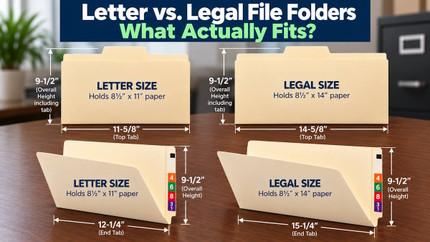
Letter-size folders hold 8-1/2" x 11" paper. Legal-size folders hold 8-1/2" x 14" paper.
Most everyday business records fit in letter-size folders. Legal-size folders are generally used for longer documents found in law offices, government agencies, real estate offices, and businesses maintaining older records.
What Are the Actual Dimensions of File Folders?
The outside dimensions of a file folder are larger than the paper it holds. The folder needs enough room to keep the edges of the documents protected.
Here are the standard measurements for common top tab and end tab folders.
| File Folder Type | Overall Dimensions |
|---|---|
| Letter Size, Top Tab | 11-5/8" W x 9-1/2" H |
| Legal Size, Top Tab | 14-5/8" W x 9-1/2" H |
| Letter Size, End Tab | 12-1/4" W x 9-1/2" H |
| Legal Size, End Tab | 15-1/4" W x 9-1/2" H |
These measurements include the tabs. On a standard top tab folder, the front panel is approximately 9" high, with the tab extending another 1/2". End tab folders have the tab along the side, which accounts for their additional width.
Not every folder follows these exact measurements. Specialty folders, classification folders, and certain filing systems may use different dimensions.
Does It Matter Whether You Use Top Tab or End Tab Folders?
Yes. The tab location generally depends on how your files are stored.
Top Tab File Folders are designed for filing cabinets and drawers. The labels are positioned at the top so you can read them while looking down into the drawer. You'll find these in most traditional office filing systems.
End Tab File Folders are made primarily for open-shelf filing. The labels face outward, making files easier to identify without pulling them off the shelf.
Medical offices, dental practices, law firms, and records departments commonly use end tab folders. They're also well suited for color-coded alphabetical and numerical filing systems.
Both styles are available in letter and legal sizes.
Why Are Legal-Size File Folders Still Used?
Legal-size paper was more common years ago, particularly for contracts, court records, and other lengthy documents.
Today, plenty of legal paperwork is printed on standard letter-size paper. That doesn't mean legal-size folders have disappeared.
Many businesses still maintain older files containing 8-1/2" x 14" documents. Others continue using legal-size forms as part of their regular paperwork.
A legal-size folder can hold letter-size paper, but a letter-size folder won't properly accommodate a 14-inch document without folding it.
If your files contain both sizes, legal-size folders may be worth considering.
Check Your Filing Cabinet Before Ordering
The size of the paperwork is only part of the decision.
Not every file cabinet accommodates legal-size folders. A drawer set up for letter-size hanging folders may need different rails or adjustments before legal-size folders will fit.
For an existing filing system, check the paper size, tab location, and dimensions of the folders you're replacing.
Also pay attention to fasteners, reinforced tabs, and expansion scores. If you're matching folders already in use, those details matter.
Choosing the Right File Folders
For general office paperwork, letter-size folders are usually all you need. Legal-size folders make sense when you're storing 14-inch documents or maintaining a filing system already built around them.
There's no benefit to ordering larger folders unless you need the space.
At Advanced Filing Concepts, we've supplied file folders and filing supplies since 1984. We carry letter and legal sizes in top tab, end tab, manila, colored, fastener, and other styles.
If you're replacing an older folder and aren't sure what you have, contact us with the part number or dimensions. We'll help you match it.