
 USD
USD

Continuation & Clinical Data Forms
Continuation & Clinical Data Forms
Keep patient records complete and easy to follow with continuation and clinical data forms. These forms extend existing charts with extra space for progress notes, vital signs, lab results, and follow-up visits, so you don’t have to squeeze important clinical details into the margins or start a new chart prematurely.
Extend Patient Charts with Continuation & Clinical Data Forms
Use these forms anywhere you need additional documentation space tied to an existing record:
- Progress note continuation sheets for ongoing visits and follow-up care.
- Clinical data and flow sheets for vitals, intake/output, and monitoring trends.
- Lab and test result logs to track key values across time.
- Nursing and provider documentation for multi-disciplinary care teams.
- Specialty-specific data forms to capture the details that don’t fit on standard history and physical forms.
Most forms are sized for standard 8.5" × 11" charts and work with common medical file folders, dividers, and labeling systems.
Sub Categories

Advanced Filing Concepts
Continuation Form, 8-1/2" x 11", Two-Sided, Black Print, 2-Hole Punched, 100/Pack (29014)

Advanced Filing Concepts
Continuation Form, 8-1/2" x 11", Two-Sided, Unpunched, 100/Pack (CF8111)

Advanced Filing Concepts
Clinical Data Form, 8-1/2" x 11", Two-Sided, Dark Green, 2-Hole Punched, 100/Pack (CF8288)
Advanced Filing Concepts
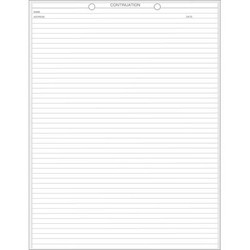
Continuation Form, 8-1/2" x 11", Two-Hole Punched, 100/Pack (CF8290)

Advanced Filing Concepts
Progress Notes Form 2-Sided, Blue Ink, 2HP at top, 100 per Pack


Tabbies
Health Insurance Claim Forms, Form 1500, White/Red Print, Laser Sheets, 500/Pack
Clinical Data Forms That Work with Your Existing Charts
Primary admission and history forms rarely have enough room for an entire course of care. Continuation and clinical data forms give you extra space for daily notes, orders, and responses to treatment, while claim forms connect that care to accurate billing. Keeping both clinical and billing information aligned makes it easier to see what was done, why it was done, and how it was billed.
Progress Notes Forms for Ongoing Documentation
The 2-sided Progress Notes Form in this category provides lined, blue-ink documentation space on both sides, with 2-hole punching at the top so you can drop it directly into fastener folders or chart dividers. Each pack includes 100 forms, giving providers plenty of room to document follow-up visits, phone calls, consults, and narrative notes without crowding the initial H&P.
Date and signature lines (where provided) help tie each entry to the right encounter and clinician, supporting clearer charting and audit trails.
CMS/HCFA 1500 Claim Forms for Professional Billing
Tabbies Healthcare Forms CMS/HCFA 1500 Claim Forms (14540) follow the standard CMS-1500 layout used for professional medical billing. These forms help your office capture diagnoses, procedures, provider IDs, and payer details in a format recognized by insurers across the country.
Keeping a supply of pre-printed CMS-1500 forms on hand is especially useful for practices that run hybrid paper/electronic systems, rely on manual backup when software is down, or still process certain claims on paper.
Built for Standard Medical Filing Systems
Both the progress notes forms and CMS-1500 claim forms are sized to fit standard 8.5" × 11" medical charts and filing systems. Use them with:
- End tab or top tab file folders and fastener folders
- Chart dividers labeled for Progress Notes, Orders, or Billing
- File jackets and pockets for high-activity charts
- Color-coding labels for patient number, provider, or year
Because the formats are familiar and easy to read, staff can start using these forms immediately with minimal training.
Who Uses Continuation & Clinical Data Forms?
These forms are widely used by:
- Primary care and multi-specialty clinics
- Outpatient practices and ambulatory centers
- Behavioral health, rehab, and long-term care facilities
- Billing departments that still submit or back up claims on paper
Together, progress notes forms and CMS-1500 claim forms help you document what happens in the exam room and reflect it accurately on the claim.
Continuation & Clinical Data Forms FAQs
Can I file progress notes and claim forms in the same chart?
Yes. Many offices store progress notes behind a clinical tab and CMS-1500 claim forms behind a billing or correspondence tab within the same chart. As long as your folders and dividers are set up for standard 8.5" × 11" forms, both will fit easily.
When do I need paper CMS-1500 claim forms?
Paper claim forms are useful for practices that submit some claims manually, need a backup when software is down, or must mail or fax claims to specific payers. Even fully electronic offices often keep CMS-1500 forms on hand as a fallback and for training.
How many progress notes forms should I keep on hand?
That depends on your visit volume and documentation style. As a starting point, estimate how many progress entries you chart per day and multiply by your typical reordering cycle. Each pack of Progress Notes Forms includes 100 sheets, and because they are 2-sided, each sheet provides twice the writing space.