
 USD
USD

Fireproof File Cabinets vs Standard Cabinets: What Happens in a Real Office Fire?
Fireproof File Cabinets vs Standard Cabinets: What Happens in a Real Office Fire?
Wildfire risk across the United States continues to rise. Forecasts heading into 2026 show large portions of the country facing drought conditions, especially across the western states and parts of the Plains. When dry conditions combine with warmer temperatures, the risk of structure fires increases.
Many businesses still rely on paper records every day. Legal files, medical charts, financial documents, property records, and signed agreements often exist in physical form only. When a fire occurs, those records can be lost in minutes if they are stored in an ordinary metal cabinet.
That is exactly why fireproof file cabinets exist. They are built to protect paper records when temperatures inside a building rise high enough to destroy standard storage.
Standard metal file cabinets vs fireproof file cabinets
A common misconception is that a regular steel file cabinet offers protection during a fire. In reality, it provides almost none.
Paper begins to char at approximately 387 °F and will ignite around 451 °F. During a typical structure fire, temperatures can exceed 1,100 °F and may climb even higher depending on what is burning inside the building.
Standard file cabinets are usually made from thin sheet steel. Steel conducts heat quickly, which means the temperature inside the cabinet rises rapidly during a fire. Even if the cabinet itself remains standing, the documents inside are often destroyed.
Fireproof file cabinets are engineered very differently. Instead of a single layer of metal, they use multiple layers of insulation between heavy steel panels. That insulation slows heat transfer and helps keep the interior temperature below the point where paper will burn.
In plain English: a standard metal cabinet stores documents. A fireproof cabinet is built to protect them.
Understanding UL fire ratings
Fireproof file cabinets are independently tested by organizations such as Underwriters Laboratories (UL) or ETL. These tests determine how long a cabinet can protect its contents under extreme heat.
Class 350
Designed for paper documents. The interior temperature stays below 350 °F, helping prevent paper from scorching or igniting.
Class 150
Used for magnetic tapes and film. These materials are more heat-sensitive and must remain below 150 °F.
Class 125
Designed for digital media such as disks, tapes, and microfiche. The interior temperature must stay below 125 °F to prevent damage.
Impact Rated
Some fireproof cabinets are also tested to withstand structural collapse, helping them remain closed and intact during severe fire events.
How fireproof cabinets are tested
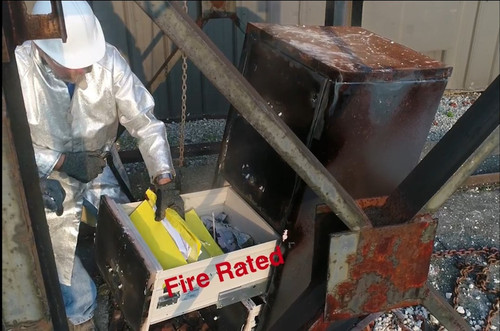
Fire testing for cabinets is intentionally extreme.
During testing, cabinets are placed in furnaces where temperatures reach 1,700 °F to 1,850 °F. The interior temperature is monitored throughout the test to confirm that it stays below the cabinet’s rated level for the full test duration.
Impact-rated cabinets go through an additional step. After exposure to extremely high heat, the cabinet is dropped 30 feet to simulate falling through a burning structure. It is then reheated to verify that the insulation and door seals still perform as intended.
These are severe test conditions. In many real office fires, temperatures peak around 1,000 °F to 1,200 °F and may last far less than an hour. That means a properly rated fireproof cabinet can provide an important safety margin when every minute counts.
Why ordinary cabinets fail during fires
After a building fire, it is common to see standard metal cabinets still standing in the debris. At first glance, they may not look destroyed.
Inside, however, the contents are often ruined.
Because metal conducts heat so efficiently, the interior temperature of a basic cabinet can rise high enough to ignite or char paper even if the exterior never melts. Without insulation to block that heat transfer, documents simply do not stand much of a chance.
Fireproof cabinets are designed to prevent that outcome by creating a thermal barrier between the outside flames and the records inside.
Choosing the right fireproof file cabinet
When selecting a fireproof cabinet for your office, a few factors matter most:
- Look for certified testing - Choose cabinets with a verified UL or ETL fire rating.
- Match the rating to what you store - Paper records generally require Class 350 protection, while digital media may require Class 125 or Class 150 storage.
- Choose an appropriate fire duration - Many offices are well served by 1-hour fire protection, while some environments may justify a 2-hour model.
- Consider water resistance - Firefighting efforts introduce water from sprinklers and hoses, so cabinet seals matter too.
- Think long term - Fireproof cabinets cost more than standard cabinets, but replacing critical records can be far more expensive.
Protecting the records your business depends on
When disaster strikes, the difference between a standard cabinet and a fireproof cabinet becomes very clear.
Ordinary metal cabinets offer no meaningful insulation against heat. Paper stored inside them will likely burn, char, or become unusable during a serious fire.
Fireproof file cabinets are built specifically to prevent that outcome. By keeping internal temperatures below the combustion point of paper, they help protect the records businesses rely on to operate.
For organizations that depend on physical documentation, investing in a properly rated cabinet is not just a storage decision. It is a business continuity decision.
Recommended fireproof storage options
If your office stores important records, upgrading to a professionally tested cabinet is one of the smartest steps you can take.
Fireproof cabinets are commonly used by law offices, medical practices, financial institutions, and government agencies that cannot afford to lose paper records.
Explore our selection of fireproof file cabinets designed to protect legal documents, business records, and vital paper files during high-temperature fire events.