
 USD
USD

7 Proven Ways to Prevent Misfiled Documents in Office Filing Systems
How to Prevent Misfiled Documents and Improve Filing Accuracy
Anyone who has worked around a busy file room knows the frustration of a misfiled document. One missing folder can send staff searching through drawers for ten minutes or longer. Multiply that across multiple employees and the lost time adds up quickly.
The good news is that most misfiles are preventable. With a few simple filing practices and the right labeling tools, offices can dramatically reduce filing errors and make document retrieval much faster.
Below are seven practical methods that records departments, medical offices, law firms, and administrative teams use to keep their filing systems accurate and efficient.
1. Keep Your Filing System Simple
One of the biggest causes of misfiles is confusion. If staff members are unsure where something belongs, they may place it in the wrong location just to move on to the next task.
A clear filing structure helps eliminate guesswork. Whether you organize files alphabetically, numerically, or by subject, make sure the rules are consistent and easy for everyone to follow.
Simple systems are easier to train, easier to maintain, and far less likely to produce filing errors.
2. Use Color-Coded Labels
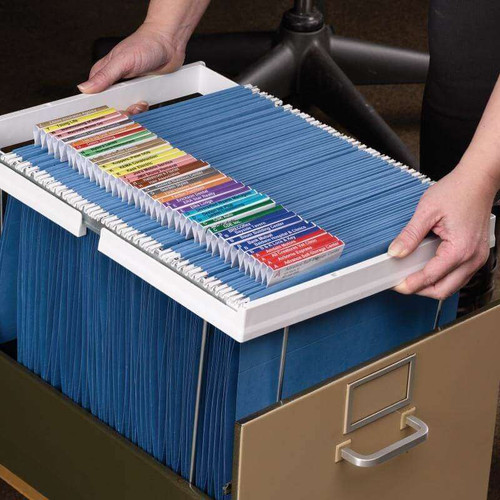
Color coding is one of the most effective ways to prevent misfiles. When labels include color bars or color blocks, they create visual patterns across the file drawer.
If a folder is placed in the wrong position, the pattern breaks immediately. Staff can often spot the mistake without even opening the folder.
Many organizations create their own systems using blank, printable labels and their choice of label creating software to create this visual sequence.
You can also combine color systems with year labels or alphabetical labels to improve organization even further.
3. Leave Space in Your File Drawers
Overfilled drawers are another common cause of filing mistakes. When folders are packed too tightly together, it becomes difficult to see label sequences or insert folders in the correct location.
Crowded drawers also encourage rushed filing. Staff may simply force a folder into the nearest space rather than locating the proper position.
Leaving adequate room for growth makes files easier to scan and helps maintain the visual order of your filing system.
4. Use Outguides or Charge-Out Systems
Sometimes a file appears to be missing simply because someone else is using it. Without a tracking system, staff may spend valuable time searching for a file that is actually sitting on someone's desk.
An outguide solves this problem. When a folder is removed from the drawer, an outguide is placed in its location with the name of the person who took the file.
This simple practice makes it easy to identify where a file went and who last handled it.
5. Archive Inactive Records
Another common cause of filing confusion is keeping too many old documents in active file drawers. When inactive files accumulate, it becomes harder to locate current records.
Establish a regular process for archiving older material. Moving inactive records to storage keeps the active filing system smaller and easier to manage.
6. Standardize Label Placement
Labels should always be placed in the same position on every folder. When labels shift around or appear in different locations, it becomes difficult to visually follow the filing sequence.
Consistent placement allows staff to quickly scan rows of folders and verify that files are in the correct order.
Using standardized folders such as top tab and end tab file folders also helps maintain uniform labeling.
7. Train Staff on Filing Procedures
Even the best filing system will fail if staff members are not properly trained. Every employee who handles records should understand the filing rules and how to read the labeling system.
Training should include how files are indexed, where new folders should be created, and how to verify the correct filing position before inserting a folder.
Building a Filing System That Works
A reliable filing system combines clear procedures with good visual organization. Color-coded labels, consistent folder placement, and proper drawer spacing all help staff identify errors before they become bigger problems.
With the right system in place, finding documents becomes faster and filing mistakes become far less common.
To explore labeling systems and filing tools used by offices across the country, visit our complete selection of filing supplies.